Showing posts with label Churches. Show all posts

Monday, February 20, 2012

Who's Got the Action? (1962) - Film Locations


Dean Martin and Lana Turner headline this story about a man with a gambling addiction (Martin) and his wife (Turner) who does what she can to make sure her husband doesn't lose all of their money. The setup is quite a stretch. Turner has Martin's law partner (Eddie Albert) lead Martin to believe that Albert has found the best bookie in town, that bookie, being Martin's wife. The idea is if Martin loses then the money will stay in the household, but unfortunately, Martin goes on a winning streak, forcing Turner to sell their possessions to cover the winnings. Meanwhile, a real bookie in town (Walter Matthau ) is wondering who it is that is getting all the action? 

Despite the tagline claiming to be "the most riotous bedtime story ever!" Who's Got the Action? (1962), really isn't that riotous at all. Even at an hour and a half the movie feels long. Most of the gags just are not that funny and the plot struggles to unfold. I think a more appropriate tagline would be "a mildly amusing bedtime story,"because the film does have some merits.

My favorite part of Who's Got the Action? is seeing Matthau in one of his early film roles. He's the most fun to watch and steals every scene he is in. I also liked the 1960s set designs, particularly the interior of the apartment where Martin and Turner live.

The apartment building where Martin and Turner live is the Talmadge apartments located at 3278 Wilshire Boulevard. This building was built by Joseph M. Schenck in 1922 for his wife, the silent screen actress, Norma Talmadge. 

The Talmadge apartments as seen in the film.

The Talmadge building as it appears today.

The screenshot below shows Martin and Turner leaving the Talmadge apartments and driving down Wilshire Boulevard. They're in the red car, passing Immanuel Presbyterian Church.

Immanuel Presbyterian Church, 3300 Wilshire Blvd

Immanuel Presbyterian Church as it appears now.

Below is a side view of Immanuel Presbyterian Church looking across South Berendo Street from the Talmadge apartment building.

Martin about to enter the Talmadge building. Immanuel 
Presbyterian Church is in the background.

Side view of the church looking across S. Berendo St.

Each day Turner walks to the newsstand outside of the Thrifty drug store to read the paper and see the results of the horse races. The Thrifty drug store was located at 3333 Wilshire Boulevard, just a couple blocks down from the Talmadge apartment building. The Thrifty drug store is gone and now a modern office building, completed in 1983, stands in its place.
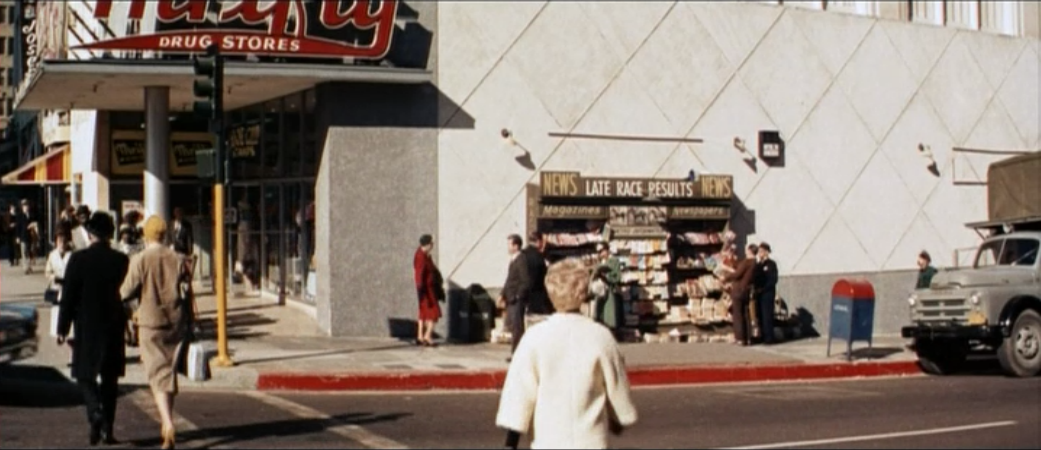
Turner visits the Thrifty Drug Store at
3333 Wilshire Boulevard, Los Angeles

A glass and steel skyscraper now stands at
3333 Wilshire Boulevard.

Turner fainted when she saw the results of the races. Eddie Albert helps Turner back to her apartment. In the screenshot below we can see the Talmadage apartment building a couple blocks up in the background. The building in the foreground is a bank and that building is still being used as a bank today.

Eddie Albert helps Turner back to the Talmadge apartment.

Looking up Wilshire at the corner of S. Catalina Street.

A year later, in 1963, Dean Martin made another "bedtime story" comedy called Who's Been Sleeping in My Bed? That film isn't a knee jerker either, but it is closer to the "riotous" tagline that this film claims. You can see some of the film locations from Who's Been Sleeping in My Bed? here.

Who's Got the Action? is currently available as a Watch Instantly title on Netflix and will be released on DVD on March  27, 2012.

Sunday, October 23, 2011

The Big Night (1951) - Film Locations

The Big Night (1951)

Director Joseph Losey had a short career making films in America before he was forced to move to Europe after being blacklisted in Hollywood during the era of red-baiting and HUAC hearings. So, it's no surprise that Losey's films didn't get much attention in the United States, especially those films that he made in Europe. Although Losey's films are highly regarded in Europe, they're still not widely recognized and appreciated in the United States, which is a real shame because Losey made some real gems.

A few weeks ago I did a film locations post for one of Losey's American films, The Lawless (1950), which was filmed in Northern California. This time around I spotlight some of the film locations for The Big Night (1951) which was filmed in Los Angeles.

Like many noir films, The Big Night (1951) is a revenge story with a very simple plot, but I was quite surprised at just how dark and moody this film was. The film stars a young John Drew Barrymore, a teenager who witnesses his father beaten to a pulp. Barrymore takes to the streets with the intention of getting back at his father's attacker, but when he confronts the man that beat his father, he discovers some dark secrets about his father. But are they true? Things are little more complicated than Barrymore thought.

In one scene when Barrymore is wandering the streets he comes up to an old church. The building is St. Joseph Catholic Church located at 218 East 12th Street in Los Angeles. The church was constructed in 1901 and stood on the site for many decades, until in 1983 a fire damaged the church and the building was demolished. A new church was then erected in its place. Below is a screenshot from the film of Barrymore approaching the church matched with some images of the church during different time periods.

Barrymore at St. Joseph Catholic Church, Los Angeles

St. Joseph Catholic Church in 1906

St. Joseph Catholic Church ca. 1940

St. Joseph Catholic Church as it appears today.

During the opening of the film and later in the story, we see Barrymore running down the streets where the Southern California Gas Company tanks once stood. The intersection below is Center Street at Commercial Street near downtown Los Angeles.

Barrymore between the Southern California Gas Company tanks.
Center Street at Commercial Street, Los Angeles

Center Street at Commercial Street, Los Angeles

Barrymore running down Center Street passed the Friedman Bag
building, now the Devon Self Storage building.

Center Street at Commercial, Los Angeles
Former Friedman Bag building on left.

Side street next to the Friedman Bag building.

Looking down the side of the former Friedman Bag building.

The Big Night (1951) is currently available for streaming on Netflix Watch Instantly, but is not to be confused with the film from 1960 with the same title. To my knowledge it has not been released on DVD in the United States, but it is available on DVD as part of the Joseph Losey collection box set released in the United Kingdom.

Street View images (c) Google (2011), St. Joseph Catholic Church images from Los Angeles Library photo collection.

Saturday, October 15, 2011

Donovan's Brain (1953) - Film Locations

Donovan's Brain (1953)

It's not a horror film, but Donovan's Brain (1953) is creepy enough (ok, campy enough) for October Halloween viewing.  In the film, Lew Ayres plays Dr. Patrick Cory, a scientist experimenting with keeping monkey brains alive outside of their bodies. When a millionaire by the name of Donovan crashes nearby Dr. Cory's home and lab, Dr. Cory volunteers to help resuscitate the victim. When that fails, Dr. Cory secretly removes Donovan's brain and attempts to keep the brain alive outside the body. The experiment seems to work until Donovan's brain begins to take control of Dr. Cory.

Many of the scenes take place at the home of Dr. Cory, which looks to be a remote area of Southern California. However, there are a few scenes that take place in Los Angeles. In an early scene when Lew Ayres needs to go into the city, we see his plane flying over downtown Los Angeles with a view of City Hall in the background.

Lew Ayers flies over Los Angeles. City Hall in background.

Bird's eye view of City Hall in Los Angeles as it appears today.

When Ayers needs to stay in Los Angeles for a few days he crashes at The Town House apartment building located at 639 S. Commonwealth Ave. This same apartment building can be seen 22 years earlier in the Charlie Chaplin film, City Lights (1931) in the scene where Chaplin, after receiving money from a millionaire, runs out of the apartment to buy the basket of flowers from the blind girl. Below are comparisons of the Town House apartments as they appear in the film and how the building appears today.

Lew Ayres arrives at the Town House apartments.

639 S. Commonwealth Ave, Los Angeles

The entrance to The Town House apartments.

A present view of the entrance to The Town House apartments.

The Town House Apartments, 639 S. Commonwealth Ave.

I'm not a hundred percent sure, but it looks like there may have actually been scenes filmed inside The Town House apartments building. Usually, a film production would recreate the interiors on a soundstage at the studio, but the screenshots below look like they may be an authentic look at the interior of the Town House apartments circa 1953.

Lew Ayres enters The Town House apartments.

Ayers goes up the steps to the lobby.

Ayers in the lobby of the Town House apartments.

The elevators inside the Town House apartments.

In the next scene comparison Lew Ayres is seen leaving The Town House apartments, getting into a cab parked on Commonwealth Ave. In the background you can see the First Congregational Church of Los Angeles, the same church where James Mason brings his family in the Nicholas Ray film, Bigger Than Life (1956). In the modern day view you can just barely see the church steeples peeking above the trees and partially blocked by the modern glass building.

Looking down Commonwealth Ave 
outside the Town House apartments.

Looking down Commonwealth Ave, the First Congregational 
Church of Los Angeles in the upper right corner.

In one scene when Lew Ayres is going about town he is spotted by a reporter. In the screenshot below, we can see that the building Ayres goes into was on South Olive Street near West 7th Street. The building in the background can also be seen in Charlie Chaplin's film City Lights, in the opening credits of the Joan Crawford film, Possessed (1947),  and in the Pat O'Brien and Bette Davis film, Bureau of Missing Persons (1933).

Reporter on S. Olive near W. 7th Street, Los Angeles

S. Olive near W. 7th Street, Los Angeles

Near the end of the film, Lew Ayres is almost completely controlled by Donovan's brain. Under Donovan's control, Ayres nearly gets killed by stepping in front of moving traffic. The scene was filmed near the intersection of Wilshire Blvd and S. Westmorland.

Ayres on Wilshire Blvd near S. Westmorland. The art deco
Bullocks Wilshire building can be seen on the right.

Looking east down Wilshire. Bullocks Wilshire building on right.

Looking down S. Westmorland near Wilshire Blvd.

Looking down S. Westmorland near Wilshire Blvd. 
The side street is now divided in half.

Donovan's Brain (1953) is available on DVD and is currently available to Watch Instantly on Netflix. 

The film also stars Nancy Davis, later known as Nancy Reagan and Gene Evans.

Bird's Eye View (c) 2011 Microsoft Corporation, Pictometry Bird's Eye (c) 2010 Pictometry International Corp, Google Street View (c) 2011 Google

Your thoughts?

Monday, September 5, 2011

Bigger Than Life (1956) - Film Location


The first Nicholas Ray film I ever saw and I imagine is the case for many people, was Rebel Without a Cause, with James Dean and Natalie Wood. I was just a teenager who at the time was more interested in seeing James Dean. Even as a teen in the early 90s James Dean was still cool. But when I watched Rebel, it wasn't just Dean that sucked me in, it was the dramatic way the film was captured, such as the faraway camera shots and the striking camera angles, like the opening scene where the camera is looking up at James Dean lying on the ground, playing with a toy. It was the Nicholas Ray touch that made this teen drama so engaging.

Ray might not have been a Billy Wilder or a John Ford, but he had his own style that made him great and it was the auteurists who started the French New Wave that first recognized Ray's greatness. Appropriately, in college, when as a student I was expanding my knowledge of classic cinema, I discovered more of Ray's films and began to appreciate him as a director. The more I saw the more I liked Ray as a director. In A Lonely Place and On Dangerous Ground became fast favorites. 

This past August marked the centennial of Nicholas Ray and to celebrate, Tony Dayoub of the blog Cinema Viewfinder is hosting a Nicholas Ray blogathon, starting today and running through September 8, 2011.  To read all the entries, visit Cinema Viewfinder by clicking here.

This is the first blogathon I have chose to participate in. The subject of Ray was just too good to pass up. As my contribution, I'm sticking with the theme of this blog so I am celebrating Ray's centennial with a look at some of the filming locations for three of his classics: Bigger Than Life (1956),  In A Lonely Place (1950), and Rebel Without A Cause (1955).

In Ray's film, Bigger Than Life, James Mason plays a father and school teacher who becomes seriously ill. When it appears that Mason's illness is hopeless, Mason becomes dependent on a miracle drug to cure him. The only problem is the drug causes Mason to go mad and he begins to scare and hurt those around him.

There are not many external film locations in Bigger Than Life, but there is one scene where Mason and his family go to a church service. That church is the First Congregational Church of Los Angeles, located on the NE corner of Sixth Street and Commonwealth Avenue in the Wilshire District. The church is the oldest continuous Protestant Church in the city.

First Congregational Church of Los Angeles
as seen in Bigger Than Life (1956)

First Congregational Church of Los Angeles present day.
(c) Google 2011

Bigger Than Life also stars Barbara Rush as Mason's husband and Walter Matthau as Mason's friend.

For more Nicholas Ray film locations check out my previous posts on:


Your thoughts?

Saturday, February 5, 2011

The Wedding of Ronald Reagan and Nancy Davis

Ardis Holden, Ronald & Nancy Reagan, William Holden
Photo from Ronald Reagan Library

This Sunday is not only a big day for football fans who are getting ready to watch the Green Bay Packers take on the Pittsburgh Steelers in the Super Bowl, but for political junkies and classic film fans it marks what would have been the 100th birthday of Hollywood actor turned President, Ronald Reagan. A year long centennial celebration will be taking place with various events happening all over the globe. Visit the official centennial page for a complete overview.

Prior to making his way to the White House, Reagan was a working actor in Hollywood, making most of his films under contract at Warner Bros. in films like Knute Rockne: All American, Kings Row, Dark Victory and numerous patriotic war films. In 1937, Reagan became a member of the Screen Actors Guild (SAG) and by 1946 he was asked to run for president of SAG. Reagan would serve five terms as president. During his time as president of SAG Reagan became increasingly more conservative and more interested in politics. Some have speculated that Reagan's first wife, the more liberal actress Jane Wyman, divorced Reagan due to his increasingly vocal interest in politics. However, there were also allegations that Wyman was having an affair with her Johnny Belinda costar, Lew Ayres. So who knows what the real reasons were - probably a combination of both. 

Ronald Reagan would meet his future wife Nancy Davis in 1951. Nancy had arranged to meet Reagan at La Rue, a Sunset Strip restaurant, to discuss a problem concerning her name being used in an advertisement in the Hollywood Reporter. The two began dating and found that they both had a lot in common, particularly an interest in conservative politics. The next year, while having dinner at the Beverly Hills restaurant Chasen's, Reagan asked Davis to marry him.


The Little Brown Church on Coldwater Canyon, Studio City

The wedding, which took place on March 4, 1952, was a very small affair. Reagan's good friend and fellow actor William Holden, would be best man. Holden's wife Ardis was the matron of honor. The Holden's were the only guests. Ardis made the arrangements for a wedding ceremony to be at The Little Brown Church on Coldwater Canyon in Studio City. The name is completely accurate. If you look at the photos above and below you can see that the church is in fact "little" and "brown." It's not some ornate location one would expect a Hollywood couple to be married. The church has been open since 1930 and is still open today, so you too could be married in the same church!

The Little Brown Church, Studio City

After the ceremony at the Little Brown Church the foursome headed to the Holden's home in neighboring Toluca Lake for dinner and a small reception. The photo below shows Reagan and Nancy cutting the cake at the Holden's home.

Ronald & Nancy Reagan, Newlyweds

After the wedding Reagan and Nancy spent the first night of their honeymoon at the historic Mission Inn in Riverside, California. It was then onto Phoenix, Arizona where the newlyweds visited with Nancy's parents.

A happy birthday to Reagan and to my brother who also celebrates a birthday.