Showing posts with label A.C. Lyles. Show all posts

Saturday, November 27, 2010

William Holden, Hollywood's Golden Boy

William Holden (1930s)

After a couple of small parts in some mediocre films, William Holden was finally being cast in the lead role of a film that Harry Cohn, the head of Columbia Pictures, hoped would make his handsome acting acquisition a major star. The year was 1939 and the film was Golden Boy, which also starred Barbara Stanwyck and Adolphe Menjou

Unfortunately, the film's success was mild and it would be a few years before Holden would get such a major role again. This was the magical year 1939, the same year that Gone With The Wind, The Wizard of Oz, Dark Victory, Mr. Smith Goes to Washington, Stagecoach and so many other memorable films were released, so Golden Boy had some tough competition at the box office. Nevertheless, Holden would always be known throughout the rest of his career as Golden Boy.

Holden was initially signed under contract to Paramount Pictures after being discovered by talent scout Milt Lewis. It was only by chance that Holden got the part in the Columbia film Golden Boy. Harry Cohn initially wanted John Garfield to star in Golden Boy, but Jack Warner at Warner Bros. refused to loan his star out. The producer of Golden Boy, William Perlberg, suggested they go after an unknown actor, how David O. Selznick did for casting the role of Scarlett O'Hara for Gone With the Wind.

Unknown actors auditioned for the part, including a young Alan Ladd. Other studios submitted screen tests of actors they had under contract. Paramount submitted a screen test with Margaret Young for another unfilled part in the film. In the screen test, reading opposite of Young, was Holden. When Perlberg and the film's director Rouben Mamoulian watched the test they were immediately drawn to Holden. Perlberg and Mamoulian convinced Cohn that Holden was the right guy for Golden Boy and to find out from Paramount who the young actor was.

Cohn phoned Y. Frank Freeman, the production chief at Paramount, to let him know he wanted not only to borrow Holden for his film, but that he also wanted to buy half his contract. Paramount was only paying Holden $50 a week, which meant Cohn could get a potential star for just $25! Freeman agreed and Holden went to work on Golden Boy.

Hollywood Athletic Club, where Holden stayed
during the filming of Golden Boy

To prepare for the part of Joe Bonaparte in Golden Boy, Holden needed to learn how to box, play the violin, and he also needed to take some acting lessons. This meant Holden needed to get up at 6 a.m. every day to drive the 14 miles from his home in South Pasadena to the Columbia studio lot. He often didn't get home to bed until after midnight.  Holden became exhausted and complained to Artie Jacobson, a talent exec at Paramount. Jacobson suggested that he stay at the Hollywood Athletic Club, which was less than a mile from the Columbia studio lot.

Holden was now closer to the studio, but after he received his first paycheck, he noticed that the studio had deducted $60 for rent. Holden complained to Cohn that he was only being paid $50 and now they were deducting $60 from his check - that wasn't right. Holden demanded that the studio pay his rent. Cohn yielded to Holden's request. 

Brown Derby Restaurant on Vine Street, Hollywood

A.C. Lyles, who at the time was working in Paramount's publicity department, helped Holden move into the Hollywood Athletic Club. The two became fast friends. To read another post on A.C. Lyles click here.

After the release of Golden Boy, Holden was loaned out to Warner Bros. to work on the film Invisible Stripes. One night, after Invisible Stripes was released in theaters, Lyles and Holden had dinner at the Brown Derby restaurant on Vine Street. Above is an image from my postcard collection of the Brown Derby as it would have looked at the time.  After dinner the two men drove down Hollywood Boulevard and as they came up to the Warner Theatre, Lyles noticed that the name "William Holden" appeared on the theatre's marquee. 
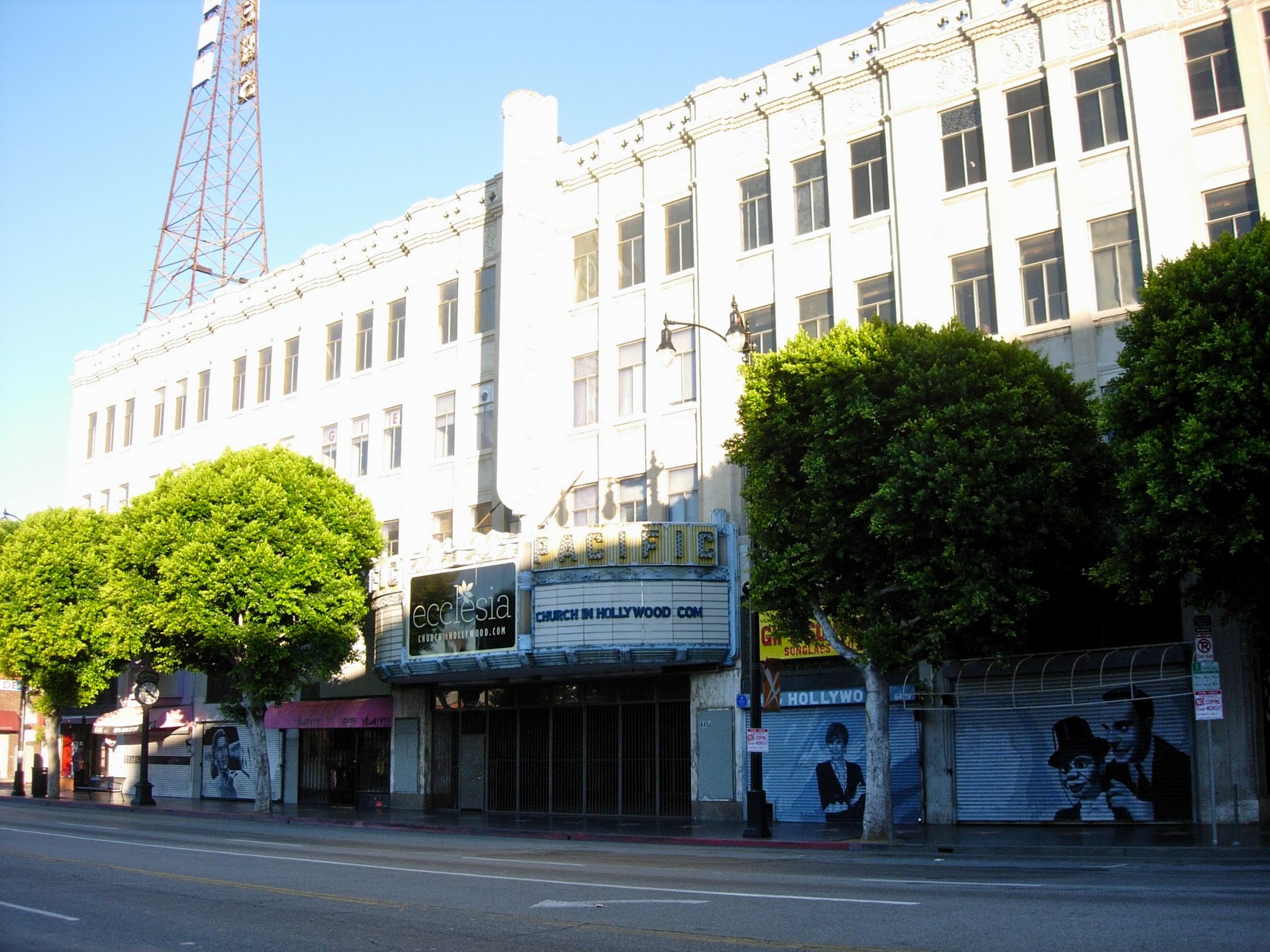

Former Warner Theatre on Hollywood Boulevard

According to Bob Thomas's biography, "Golden Boy: The Untold Story of William Holden," Lyles commented to Holden, "That must make you feel very proud."

"It doesn't mean a thing to me," Bill replied. "That's another fellow up there on that theater. I'm Bill Beedle [Holden's real name], who is somebody entirely different. I'm grateful that they changed my name. I want to keep myself separated from that other guy."


Your thoughts?

Sunday, February 8, 2009

A.C. Lyles - "Mr. Paramount"


For anyone looking to get into business in Hollywood A.C. Lyles, the longtime Paramount Pictures producer has the perfect advice: "obsession, obsession, obsession." Lyles, who started working for Paramount over 80 years ago and still shows up for work today should know what works.
When Lyles was just 10 years old he saw the Paramount film Wings, which was the first picture to win the Oscar for Best Picture, at a Paramount owned movie theatre in his hometown of Jacksonville, Florida. Lyles fell in love with the picture and knew that he wanted to go to work for the people that made it so he went to the theatre manager, asked for a job, and got a position distributing handbills.
Four years later Paramount founder Adolph Zukor would make a visit to the Jacksonville theatre and Lyles didn't hesitate to introduce himself. Zukor told Lyles, who was interested in going to Hollywood to work at the studio, to finish high school first. After their brief meeting Lyles began writing Zukor every week. "My whole life was writing Mr. Zukor every Sunday. I was quite obsessed," Lyles said.
On another occasion Lyles was lucky enough to meet actor Gary Cooper who was in Jacksonville on his way to Miami. Lyles introduced himself to Cooper and explained how he had been writing Zukor. Cooper wrote Lyles a note and told him to include it in his next letter to Zukor. When Zukor's secretary found the note she wrote back to Lyles and then Lyles started writing letters to her too.
Taking Zukor's advice, Lyles graduated from high school then boarded a train going cross country to Hollywood with just $28 and a sack of apples, peanut butter, and bread. When Lyles arrived in Hollywood Zukor gave him a position as an office boy earning $15 a week. Lyles quickly made friends on the Paramount Studios lot, including a young Bing Crosby, Cooper, and James Cagney's sister. Cagney's sister would introduce Lyles to her brother and they would then become friends, but that was just the start. Cagney would introduce Lyles to who would soon become one of his best friends. "There's a young fellow in town I want you to meet. You'll be inseparable," Lyles recalled. The young fellow turned out to be Ronald Reagan!
At the age of 19 Lyles would become a publicity director. By the 1950s & 1960s he was producing films, especially westerns. Most recently he worked as a consultant on the tv show Deadwood but much of his time is spent playing ambassador for Paramount.
I was fortunate enough to meet A.C. Lyles several times while I was a Page at the Paramount Studios. I remember being invited into his office which is on the side of the Paramount Studios lot that used to be RKO. When you go into Lyles office there are framed photographs everywhere. Most of them are pictures of Lyles with all the stars he has known over the years: Elvis, Clint Eastwood, James Cagney, Shirley Temple, and of course Ronald Reagan.
The first time I went to Lyle's office he told me to take a seat on the couch. He was sitting behind his desk (which used to belong to Fred Astaire!) and asked me to blow on the door of his office. The door suddenly slammed shut. No, Lyles doesn't know magic - he has a control button behind his desk to close the door, but it was a funny little gimmick. Lyles then asked if I would like to see a video? I certainly did and he played a video for me of Ronald Reagan, Jimmy Carter, and George Bush congratulating Lyles on his career at Paramount. The most interesting part was when Reagan mentions during his segment that it was Lyles that first predicted that he would be president.
Lyles shared many stories and advice with me during the few times that we would meet. Much of the advice was that which was passed down to him from Adolph Zukor. Lyles told me, "Zukor used to say to me, to make it in this town you got to dress British, speak Yiddish." Every day that I saw Lyles at work he was finely dressed in a tailored suit that he picked up at Saville Row. He was the best dressed man at Paramount. Lyles also shared another nugget of wisdom that he picked up from Zukor and that was to, "get a Cadillac, join the Bel Air country club, and get a home in Beverly Hills." I told Lyles I would get right on that.
In the picture above you can see Lyles sitting at the desk in his office. If you look closely you can see that he's wearing cuff links. Those used to belong to Ronald Reagan and have the presidential seal.
Another interesting about Lyle is that he still drives himself to work each day in an old 1950s Ford Thunderbird. When he's not driving the old Thunderbird he's driving one of the new Thunderbirds that Ford came out with a few years ago designed to look like the classic Thunderbird. I'm told that Ford gave them the car for his loyalty to the Thunderbird car. I can't say for sure if that is true or not.
If you ever are in Hollywood and take a tour of the Paramount Studios be on the look out for Lyles. He loves guests and sharing his many stories. Don't hesitate to say hello.
Here's a great video of A.C. Lyles talking about western star John Wayne and western director John Ford:

Your thoughts?